What Makes a Sukajan Authentic? A Buyer's Guide
· By Hamza Ehsan
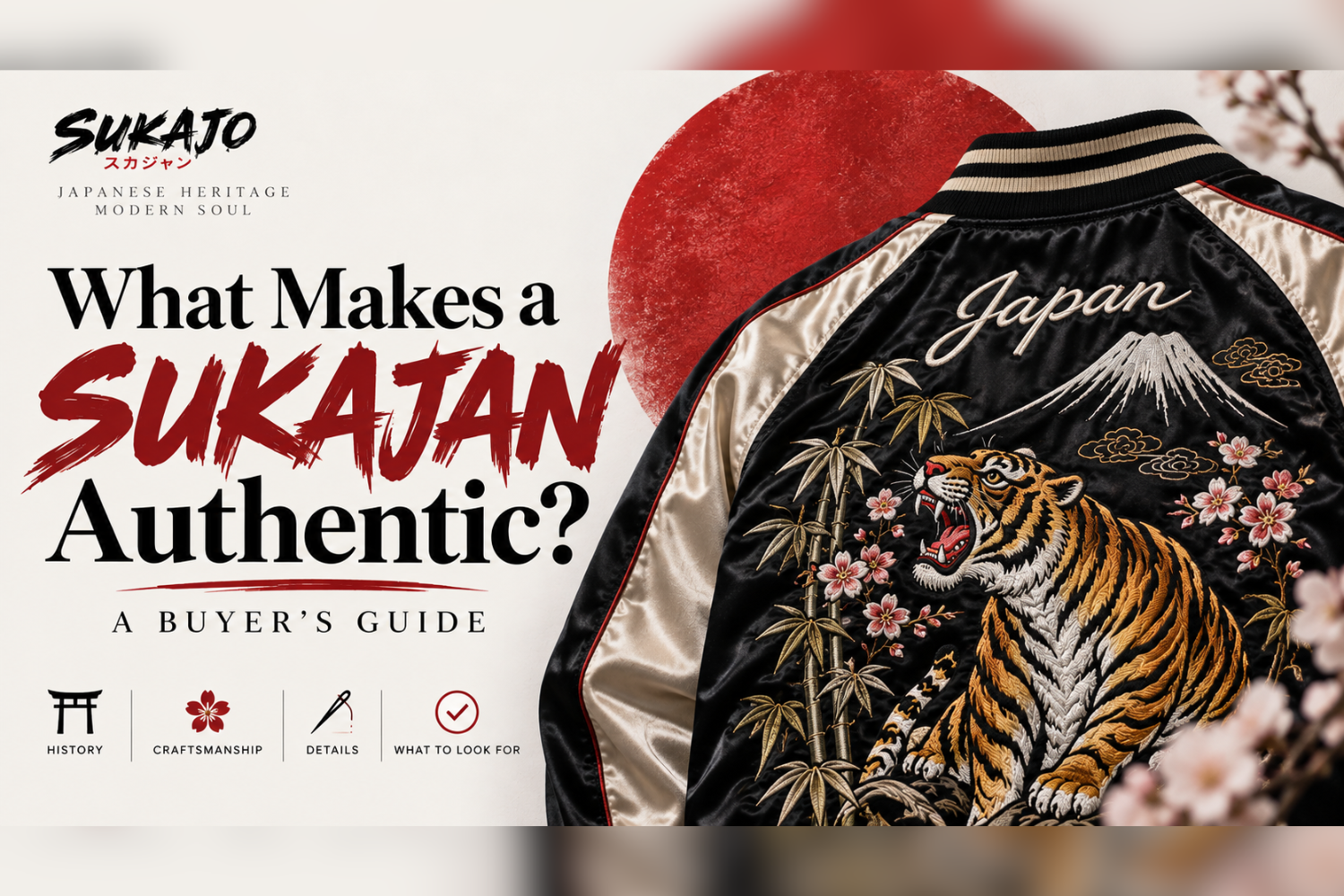
A Sukajan is easy to recognize: a glossy body, ribbed collar and cuffs, bold embroidery, and striking imagery such as dragons, tigers, eagles, cherry blossoms, or Mount Fuji. But simply looking like a Japanese souvenir jacket does not automatically make a jacket authentic.
The word authentic is often used loosely in fashion. A genuine vintage Sukajan from postwar Japan, a historically accurate reproduction, and a well-made modern Sukajan are all different products. At the same time, an ordinary bomber jacket with a printed dragon may borrow the visual style without following much of the Sukajan tradition.
For buyers, the best approach is not to rely on one feature. Instead, examine the jacket's history, construction, embroidery, fabric, silhouette, artwork, and how honestly the seller describes it.
This guide explains what really matters when choosing an authentic Sukajan and which claims deserve a closer look.
What Does an Authentic Sukajan Actually Mean?
Authenticity depends partly on what type of jacket you are buying.
An original vintage Sukajan is a period Japanese souvenir jacket, usually connected to the postwar era when American servicemen purchased embroidered jackets as reminders of their time in Japan.
A reproduction Sukajan is newly produced but deliberately recreates historical details such as acetate fabric, embroidery layouts, reversible construction, ribbing, vintage-style hardware, and period colors.
A contemporary Sukajan keeps the recognizable souvenir-jacket silhouette and embroidered identity while introducing modern colors, artwork, fabrics, or styling.
Finally, there are Sukajan-inspired bombers. These may use Japanese graphics or satin-like materials but have little connection to traditional construction.
None of these categories automatically makes a jacket good or bad. The important question is whether the seller represents the product accurately.
Start With the History of the Japanese Souvenir Jacket
Understanding the history makes judging a Sukajan much easier.
Japanese souvenir jackets developed in postwar Japan, when American military personnel began purchasing embroidered jackets as souvenirs. Japanese makers combined American-style sports jackets with embroidery and imagery associated with Japan.
Historical Sukajan commonly featured tigers, dragons, eagles, Mount Fuji, maps of Japan, military references, flowers, bamboo, and location names.
The jacket became particularly associated with Yokosuka, which had a major American military presence. The name “Sukajan” is widely connected with Yokosuka and the Japanese word janpaa, referring to a jumper or jacket.
These garments were more than decorative outerwear. Many worked almost like wearable travel records, showing where the owner had served, places visited, military units, or imagery that represented Japan.
That combination of souvenir culture, personal memory, Japanese embroidery, and American sportswear influence remains at the heart of the Sukajan.
For more background, read Sukajo's guide to the story behind Sukajan jackets.
1. Check the Sukajan Silhouette First
Do not let large embroidery distract you from the jacket underneath it.
Traditional Sukajan generally have a relatively short blouson-style body with a zipper front, knitted collar, ribbed cuffs and waistband, and an athletic silhouette.
Raglan sleeves are also strongly associated with classic souvenir jackets. Instead of a traditional shoulder seam, the sleeve extends toward the collar, creating the rounded shoulder shape commonly seen on Sukajan.
A well-proportioned jacket should look good even without embroidery.
Check whether:
- the body has a clean bomber-style shape;
- the ribbed waistband sits properly;
- the sleeves fall naturally;
- the collar keeps its structure;
- the zipper sits straight; and
- the jacket does not look excessively thin or costume-like.
If you want to compare different interpretations of the design, browse Sukajo's Sukajan jacket collection.

2. Understand What “Satin” Really Means
Many sellers describe Sukajan simply as satin jackets, but satin is not a fiber. It refers to a weave that creates a smooth, shiny surface.
Satin can be produced from acetate, rayon, silk, polyester, or blends.
Acetate and Traditional Sukajan
Acetate became particularly important in postwar souvenir-jacket production. It provided the shiny appearance associated with Sukajan while offering an alternative when silk was difficult or expensive to obtain.
For this reason, historically faithful reproductions frequently use acetate satin.
However, this does not mean every legitimate Sukajan must use acetate.
Vintage souvenir jackets were also produced in materials such as velveteen, and modern Sukajan frequently use polyester or other fabrics.
The important point is transparency.
Instead of accepting vague descriptions such as “luxury Japanese satin,” look for the actual fiber composition.
A seller should clearly tell you what the jacket is made from.
3. Examine the Embroidery Closely
Embroidery is one of the strongest characteristics of a Sukajan.
Traditional Japanese souvenir jackets became known for embroidery with visible movement and depth. Skilled operators controlled stitch direction and density to create details such as tiger fur, eagle feathers, dragon scales, flowers, clouds, and landscapes.
That means good embroidery is not simply about using thousands of stitches.
Look closely at:
- stitch direction;
- clean outlines;
- thread density;
- layered colors;
- separation between fine details;
- smooth curves; and
- how the design sits on the fabric.
A well-made tiger should not look like one solid block of thread. Its stripes, face, fur, and surrounding elements should remain readable.
Does Sukajan Embroidery Have to Be Hand Done?
No.
Traditional Sukajan embroidery itself often relied on specialized embroidery machines controlled by skilled operators. Modern computerized embroidery is also widely used.
Machine embroidery therefore does not automatically mean a jacket is fake.
The quality of the artwork, digitization, stitching, thread, and final execution matters far more than a vague claim that something is “hand embroidered.”
4. Look for Direct Embroidery Instead of Printed Artwork
Classic Sukajan imagery is strongly associated with embroidery worked into the jacket panels.
Look closely at product photos. Real embroidery should show physical thread, stitch direction, texture, and slight dimension.
Printed graphics are different.
A printed dragon on satin may create a Japanese-inspired bomber, but it does not reproduce the embroidered character associated with traditional souvenir jackets.
Large appliqué patches can also create impressive designs, but direct panel embroidery is generally closer to classic Sukajan construction.
When a seller describes a jacket as embroidered, the photographs should make that obvious.

5. Check for Fabric Puckering
Large embroidery designs place considerable tension on lightweight satin.
Examine the area surrounding the embroidery.
Some natural movement is normal, but excessive wrinkling, pulling, twisting, or puckering can indicate poor stabilization or incorrect embroidery tension.
The main back artwork should also remain properly centered while the jacket hangs naturally.
Good embroidery should complement the garment rather than distort it.
6. Understand Traditional Sukajan Motifs
Certain designs became closely connected with Japanese souvenir jackets.
Common historical motifs include:
- dragons;
- tigers;
- eagles;
- Mount Fuji;
- maps of Japan;
- cherry blossoms;
- bamboo;
- military references; and
- Japanese landscapes.
Interestingly, Sukajan artwork often combined Eastern and Western imagery. An American eagle might appear above Mount Fuji, for example.
This cultural mixture reflects the jacket's origins.
Modern Sukajan can also include koi fish, Hannya masks, snakes, cranes, peonies, waves, contemporary artwork, or completely original compositions.
A new design does not automatically make a jacket inauthentic.
The better question is whether the artwork respects the visual identity of the garment rather than simply placing random Japanese-style graphics on a bomber jacket.
See different design approaches in Sukajo's Sukajan motif collection.
7. Don't Believe Every Symbolism Claim
Buyers should be cautious when product descriptions give every dragon, flower, color, claw, or direction one supposedly fixed ancient meaning.
Japanese symbolism is much more complex.
Tigers may be associated with courage and strength, while dragons can carry associations with power, protection, water, or natural forces. Cherry blossoms are often connected with beauty and impermanence.
But meanings vary according to artistic tradition and context.
Not every historical serviceman chose a tiger because of one specific philosophical meaning. Sometimes designs were selected simply because they looked powerful, memorable, or recognizably Japanese.
Good product storytelling provides context without inventing history.
8. Is an Authentic Sukajan Always Reversible?
No, although reversibility has a very strong connection with traditional souvenir jackets.
Many classic Sukajan were designed with two fully wearable sides. A jacket might feature a tiger on one side and an eagle or Japan map on the reverse.
Reversible acetate construction became one of the most recognizable Sukajan formats.
However, reversibility should not be treated as the only authenticity test.
If you are buying a reversible Sukajan, inspect both sides.
Look for:
- finished construction on both sides;
- intentional artwork;
- usable pockets where applicable;
- clean ribbing;
- proper seams; and
- a zipper suitable for reversible wear.
A seller advertising a reversible jacket should show photographs of both sides.
9. Does an Authentic Sukajan Have to Be Made in Japan?
Original postwar Sukajan were Japanese-made, so country of origin is extremely important when evaluating an actual vintage jacket or historically accurate Japanese reproduction.
Modern Sukajan are different.
Today the style is produced internationally.
A contemporary Sukajan manufactured outside Japan can still follow traditional construction, embroidery, silhouette, and design principles.
What matters is honesty.
Terms such as Japanese style, Yokosuka inspired, or Japanese embroidery do not necessarily mean Made in Japan.
If Japanese production matters to you, look specifically for the country-of-origin information.
10. Price Does Not Prove Authenticity
An expensive Sukajan is not automatically better or more historically accurate.
Higher prices can come from:
- Japanese manufacturing;
- acetate or specialist fabrics;
- complex embroidery;
- reproduction hardware;
- limited production;
- licensing;
- designer branding; or
- vintage rarity.
Some luxury fashion jackets may cost significantly more while being less historically faithful than specialist reproductions.
Instead of asking only “How expensive is it?”, ask:
“What exactly am I paying for?”
A detailed product page should give you an answer.
11. Check Measurements Before Buying
Even an excellent Sukajan is a poor purchase if it does not fit.
Avoid relying entirely on S, M, L, or XL because sizing can vary considerably between manufacturers.
Compare the jacket's actual measurements with a jacket you already own.
Check:
- chest;
- body length;
- sleeve measurement;
- hem width; and
- shoulder construction.
Because many Sukajan use raglan sleeves, sleeve measurements may be taken differently from ordinary jackets.
There is also no universal rule that everyone should “size up one.”
Measurements are much more reliable.
Authentic Sukajan Buyer's Checklist
Before purchasing, check the following:
| Feature | What to Look For |
|---|---|
| Fabric | Exact fiber composition rather than only “satin” |
| Embroidery | Visible thread, stitch detail and clean execution |
| Shape | Short blouson silhouette with appropriate ribbing |
| Artwork | Thoughtful souvenir-jacket or contemporary Sukajan design |
| Reversibility | Both sides shown when advertised as reversible |
| Zipper | Straight, functional and appropriate for construction |
| Ribbing | Clean collar, cuffs and waistband |
| Origin | Clearly stated country of manufacture |
| Measurements | Actual garment measurements |
| Photography | Front, back, details and reverse where applicable |
| Claims | Accurate history without exaggerated storytelling |
Do not rely on one feature alone.
Look at the jacket as a complete product.
Vintage, Reproduction or Modern Sukajan?
Your best option depends on why you want the jacket.
Buy Vintage If You Want History
Vintage Sukajan appeal to collectors because of their age, provenance, period construction, embroidery, and connection with the original souvenir-jacket era.
Expect signs of wear and potentially fragile materials.
Buy a Reproduction If You Want Historical Style
A good reproduction can provide the look and construction of vintage Sukajan without requiring you to wear a seventy-year-old garment.
Look for brands that explain which historical details they reproduce.
Buy Contemporary Sukajan If You Want More Choice
Modern Sukajan allow greater flexibility in colors, motifs, sizing, and artwork while retaining the recognizable souvenir-jacket identity.
Sukajo's Sukajo Special collection offers examples of more contemporary approaches.
What About Custom Sukajan Jackets?
Customization fits naturally with Sukajan history because many early souvenir jackets were already personal objects connected with specific people, places, units, or memories.
Modern customization may include original artwork, initials, colors, text, or unique embroidery.
However, more customization does not automatically mean better design.
The strongest jackets still need balance.
Read our guide to custom Sukajan jackets if you are considering a personalized design.
Conclusion: What Really Makes a Sukajan Authentic?
There is no single feature that makes a Sukajan authentic.
A dragon does not prove authenticity. Neither does satin, reversibility, a high price, or a Japanese-looking label.
Instead, look at the complete jacket.
A strong Sukajan should connect meaningfully with the Japanese souvenir-jacket tradition through its silhouette, embroidery, materials, artwork, construction, and design intent.
For vintage pieces, provenance and period construction become especially important. For reproductions, look at how carefully historical details have been recreated. For contemporary Sukajan, focus on whether the jacket respects the character of the original style while honestly presenting its modern interpretation.
Most importantly, buy from a seller that tells you clearly what the jacket is, what it is made from, where it was made, and how it was constructed.
When you're ready to compare designs, browse Sukajo's Japanese souvenir jackets.
Frequently Asked Questions
Are all authentic Sukajan jackets reversible?
No. Reversible construction is strongly associated with traditional Sukajan and was common among classic acetate souvenir jackets, but it should not be used as the only authenticity test.
Is polyester Sukajan fake?
No. Polyester is widely used in modern Sukajan. Acetate has stronger historical relevance, but material alone does not determine whether a contemporary jacket legitimately belongs to the Sukajan style.
Does authentic Sukajan embroidery have to be handmade?
No. Traditional Japanese souvenir-jacket embroidery often involved skilled machine-operated techniques. Modern computerized embroidery can also produce excellent results.
What are traditional Sukajan motifs?
Dragons, tigers, eagles, Mount Fuji, maps of Japan, cherry blossoms, bamboo, landscapes, and military or location references all appear within the historical souvenir-jacket tradition.
Does Sukajan have to be made in Japan?
Original vintage Sukajan were Japanese-made. Contemporary Sukajan can be manufactured elsewhere, but sellers should state the country of manufacture accurately rather than implying Japanese production.
How can I tell whether a Sukajan is actually embroidered?
Examine close-up photographs. Real embroidery should show visible thread, stitch direction, texture, and physical dimension rather than a flat printed surface.
What's the difference between Sukajan and a bomber jacket?
Sukajan developed from the Japanese souvenir-jacket tradition and is particularly associated with embroidery, glossy fabrics, ribbed blouson construction, and Japanese or souvenir-inspired imagery. Bomber jacket is a much broader clothing category.
Is an expensive Sukajan always more authentic?
No. Price can reflect branding, materials, manufacturing location, rarity, embroidery complexity, or licensing. Always judge the actual jacket specifications rather than assuming price proves authenticity.